
How to Size a Pond Pump: Flow Rate, Head Height & Volume Explained
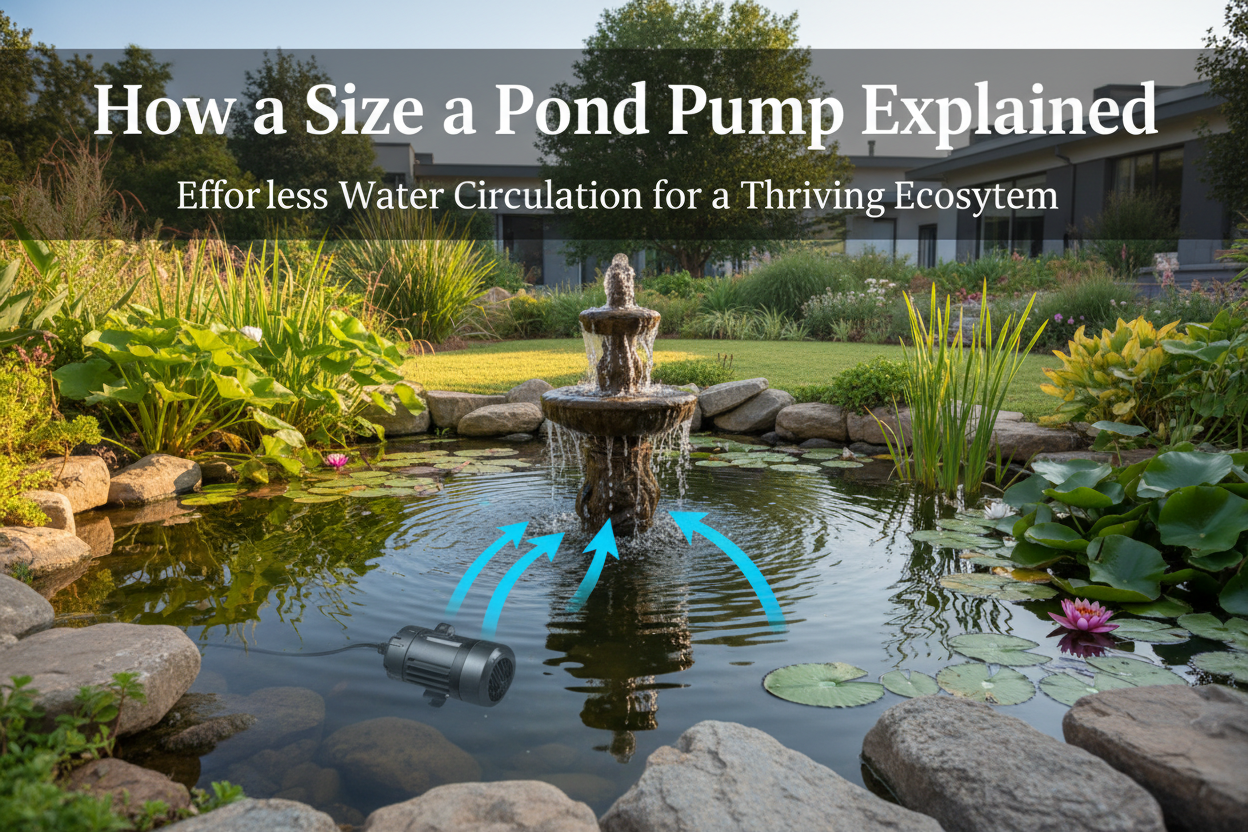
Choosing the wrong size pond pump is one of the most common mistakes garden pond owners make. Too small and your water goes stagnant; too large and you waste electricity and disturb fish. Getting the sizing right means healthy water, happy fish, and a pump that lasts.
This guide walks you through the three key calculations — pond volume, required flow rate, and head height — so you can choose with confidence.
Step 1: Calculate Your Pond Volume
Before anything else, you need to know how many litres your pond holds.
For rectangular or square ponds:
Length (m) × Width (m) × Average Depth (m) × 1,000 = Volume in litres
For circular ponds:
Diameter (m) × Diameter (m) × 0.785 × Average Depth (m) × 1,000 = Volume in litres
For irregular shapes: Divide the pond into sections, calculate each section separately, and add them together. When in doubt, overestimate slightly — it’s better to have a pump with a little extra capacity.
Example: A rectangular pond 3m long × 2m wide × 0.8m deep = 3 × 2 × 0.8 × 1,000 = 4,800 litres.
Step 2: Determine Your Required Flow Rate
Flow rate (measured in litres per hour, L/h) tells you how much water the pump moves. The right flow rate depends on what your pond is used for:
| Pond Type | Recommended Turnover |
|---|---|
| Ornamental / water feature | Full volume every 1–2 hours |
| Mixed fish pond (goldfish etc.) | Full volume every 1 hour |
| Koi pond | Full volume every 30–60 minutes |
| Pond with UV clarifier | Match pump to UV unit’s rated flow |
Formula:
Pond Volume (L) ÷ Desired Turnover Time (hours) = Minimum Flow Rate (L/h)
Example: 4,800L koi pond with 1-hour turnover = 4,800 L/h minimum.
Always size up slightly to account for flow loss through pipework, filters, and fittings.
Step 3: Calculate Head Height
Head height is the vertical distance the pump must push water — from the pump’s position (usually the pond bottom) to the highest point of discharge (your filter outlet, waterfall lip, or fountain nozzle).
Why it matters: Every pump has a flow rate vs. head height curve. As head height increases, flow rate drops. A pump rated at 5,000 L/h at 0m head might only deliver 2,500 L/h at 1.5m head.
How to measure:
- Measure the vertical height from the pump to the discharge point in metres
- Add 0.5m for every 3m of horizontal pipe run (friction loss)
- Add 0.3–0.5m for each 90° elbow fitting
Example: Filter outlet 1.2m above pond + 6m of horizontal pipe (add 1.0m) + two elbows (add 0.8m) = ~3m effective head.
Always check the pump’s flow curve at your calculated head height — not just the maximum flow rate on the box.
Step 4: Match Pump to Your Numbers
Once you have your minimum flow rate and effective head height, look for a pump that meets both requirements simultaneously — not just one or the other.
Quick sizing reference:
| Pond Size | Pump Flow Rate | Typical Head Needed |
|---|---|---|
| Up to 2,000L (ornamental) | 1,000–2,000 L/h | 0.5–1m |
| 2,000–5,000L (mixed fish) | 2,500–5,000 L/h | 1–1.5m |
| 5,000–10,000L (koi) | 5,000–10,000 L/h | 1.5–2.5m |
| 10,000L+ (large koi) | 10,000+ L/h | 2–3m+ |
Do You Need a Single Pump or Multiple Pumps?
For large ponds (10,000L+) or complex setups with both a filter and a waterfall, consider running two separate pumps:
- Filtration pump — sized for turnover rate, plumbed to your biological filter
- Feature pump — sized for head height and flow to your waterfall or fountain
This gives you independent control and redundancy if one pump fails.
Pond Pump Options at Waterhouse
We stock pumps across the full range of flow rates and head heights:
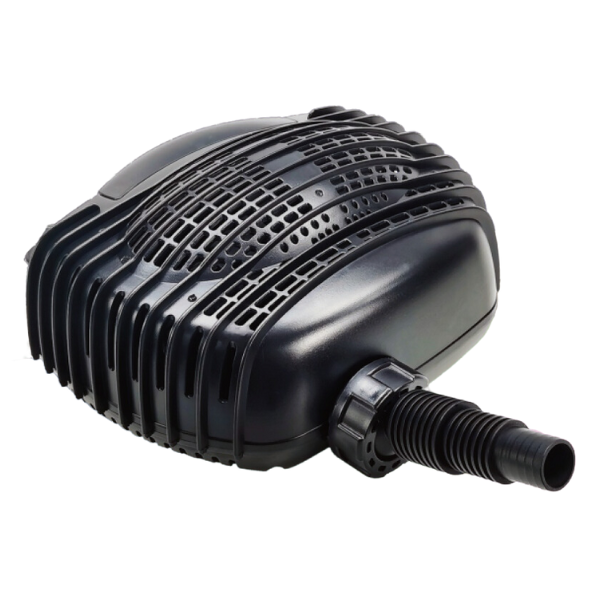
- Pond / Fountain Pumps — our core range covering small ornamental ponds through to large water features.
- High Volume Pond Fountain Pumps — for large koi ponds and high-flow applications requiring 5,000 L/h and above.
- Waterhouse Pond Pump Range — our own branded pumps, selected for reliability in South African conditions.
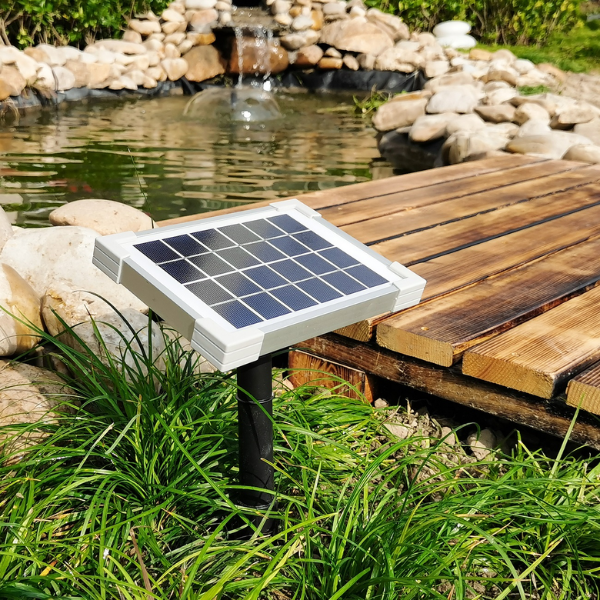
- Solar 12V Pond Pumps — if you want to run off solar, check our 12V DC range once you’ve confirmed your flow rate requirements.
Not sure which pump hits your numbers? Contact us with your pond dimensions and we’ll recommend the right model.
Common Sizing Mistakes to Avoid
- Using max flow rate instead of flow at head — always check the pump curve at your actual head height.
- Ignoring pipe friction losses — long pipe runs and multiple bends add up quickly.
- Undersizing for koi — koi produce significantly more waste than goldfish; always err on the side of more flow.
- Forgetting the UV clarifier — if you’re running a UV unit, the pump must deliver the minimum flow rate the UV requires to work effectively.
- Buying the cheapest pump — a pump running 24/7 in a South African summer needs to be built for continuous duty. Check the duty rating before buying.
Quick Sizing Checklist
Before you buy, confirm you have:
- Pond volume calculated (L)
- Required flow rate calculated (L/h)
- Effective head height calculated (m), including pipe friction
- Pump flow rate at your head height (from the pump curve) ≥ required flow rate
- Pump rated for continuous duty
- Power consumption checked (watts) — relevant for running costs
Browse our Pond / Fountain Pumps or High Volume Pond Fountain Pumps to find the right match for your pond.
-
Posted in
buying guide, flow rate, head height, koi pond, pond pump, pond sizing


Please upload banner from store admin blog pages