

Solar Pump Sizing Guide: How to Choose the Right Pump for Your Application

Choose the job first
A solar pump is sized for the water you need at the actual pumping head, not its headline maximum flow or maximum head. Use this worksheet to prepare a shortlist, then check the manufacturer's pump curve, controller and panel specifications before buying. A borehole yield test and a site survey matter where the water level or pipe route is uncertain.
Decision tree
- Water is below ground in a borehole? Start with a borehole-rated submersible pump that fits the casing. Record the pumping water level, borehole yield, delivery-tank height and pipe run. Do not assume drilled depth is the lift: the pumping water level is the relevant starting point.
- Water is in a tank or dam and must be moved to another tank? Start with a transfer pump suitable for the source. A submersible pump sits in the water; a surface pump must meet its suction-lift and priming requirements. Size for flow at the destination tank's height plus pipe losses.
- Water is already in a tank but taps or irrigation need pressure? Start with a booster pump. Include the desired pressure at the furthest outlet, elevation and pipe losses at the required simultaneous flow. Check whether the pump can supply water when needed, including after sunset.
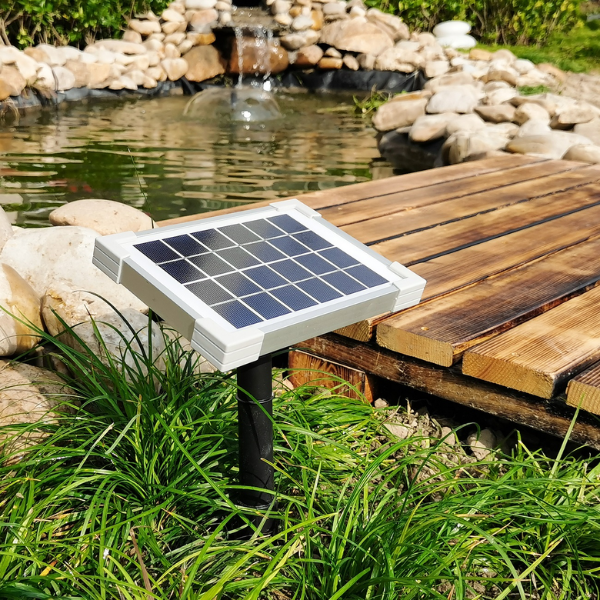
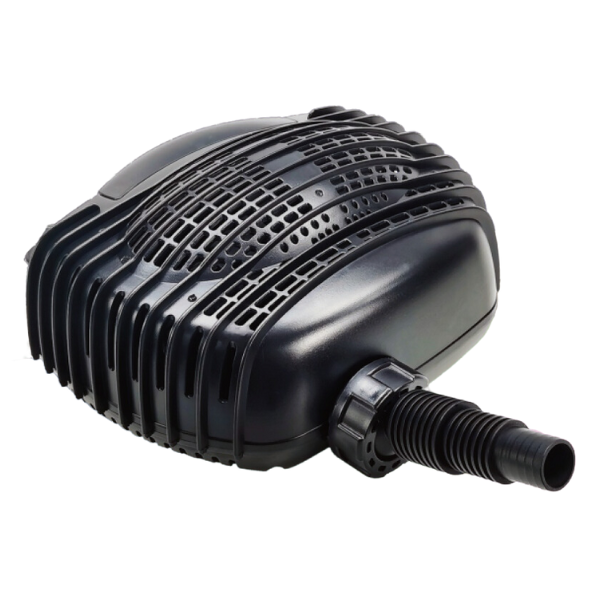
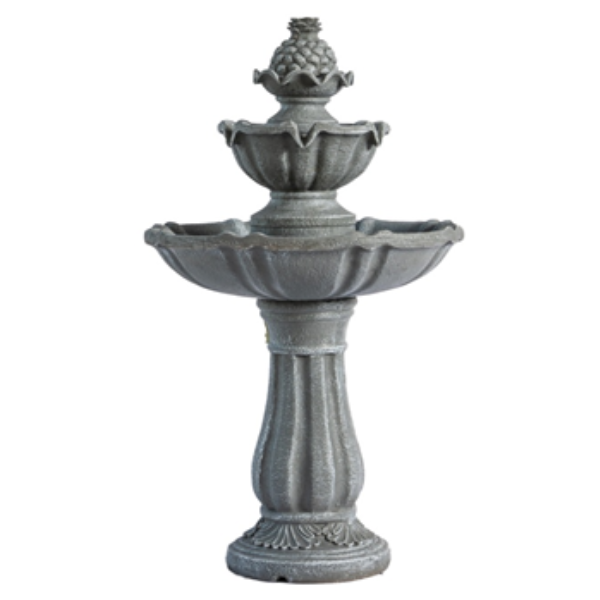
- Just circulating a pond or running a fountain? Check the kit's flow at the actual fountain height, not its zero-head flow. Browse Solar Powered Pond Pump Kits.
Calculation worksheet
| Measure or calculate | Your figure | How to use it |
|---|---|---|
| Daily water requirement (L/day) | _____ | Add household, livestock and irrigation needs; allow for seasonal demand. |
| Conservative effective pumping hours (h/day) | _____ | Use site- and season-specific solar data, not daylight duration. Allow for clouds, heat, shading and pump start/stop thresholds. |
| Target flow (L/h) | _____ | Daily litres ÷ effective pumping hours. Check the source can sustainably supply this rate. |
| Pumping water level below ground (m), for boreholes | _____ | Use measured water level while pumping, not drilled depth or static level alone. |
| Source water level to delivery point (m) | _____ | Vertical height difference. For a booster, include height to the highest outlet. |
| Required outlet pressure (bar), for boosters | _____ | Convert roughly 1 bar to 10 m of head; use the pressure required by the fixtures or irrigation equipment. |
| Total pipe length and internal diameter | _____ m / _____ mm | Include horizontal and vertical pipe, bends, valves and filters. Diameter is the pipe's internal bore. |
| Pipe friction and fitting loss (m) | _____ | Look up the loss at target flow using the actual pipe's specifications and fittings. Horizontal distance is not added directly as vertical head. |
| Total dynamic head (m) | _____ | Source-to-delivery elevation + required outlet pressure head + pipe/fitting losses. Use the pumping water level for boreholes. |
| Storage volume and days without pumping | _____ L / _____ days | Consider tank storage before adding electrical batteries. |
Example for understanding the method, not a product recommendation: If demand is 1,200 L/day and you conservatively expect 4 effective pumping hours, target 300 L/h. If the pumping water level is 35 m below ground, the tank inlet is 5 m above ground and calculated pipe/fitting loss is 8 m at 300 L/h, target about 48 m total dynamic head. Find a pump whose curve supplies at least 300 L/h at 48 m, while staying within the borehole's sustainable yield.
Distance and pipe diameter
A long run adds friction, especially through narrow pipe at higher flow. Get the internal diameter and pressure rating, measure the full route, and use a pipe-loss chart or installer calculation at your target flow. A larger pipe can reduce loss, but the right size depends on flow, length, fittings and cost. Do not use a fixed metres-of-head-per-metre-of-pipe rule for every installation.
Panels and controller
Once you have a pump that meets the target flow at total dynamic head, use that pump and its matched controller's electrical specifications to plan the array. Record the pump's rated and start-up power, controller input-voltage range, maximum open-circuit voltage and current, and the panel's rated watts, operating voltage/current and open-circuit voltage. Estimate panel count by dividing the required array wattage specified for that pump/controller by each panel's rated watts, rounding up. Then verify series/parallel wiring against voltage and current limits, including cold-weather open-circuit voltage and cable losses. Panel wattage alone does not prove a compatible system or a guaranteed daily water yield.
A dedicated solar pump controller may already optimise the pump's operation. MPPT and PWM charge controllers are not interchangeable with a pump controller; choose only equipment specified as compatible with the pump, voltage and any battery. Ask the supplier to confirm the matched array and expected flow at your calculated head for your site and season.
Battery or water storage?
For borehole-to-tank or tank-transfer jobs, storing water is often simpler than storing electricity: the pump can run when enough sun is available and the tank supplies water later. Size the tank for the water you need between pumping periods. A pressure booster that must run after sunset needs an appropriate alternative power source, battery-backed system or a gravity-fed arrangement that meets the required pressure. Check that the pump and controller actually support battery operation.
If a battery is necessary, estimate daily energy as pump input watts × hours of operation, then required usable battery energy as daily watt-hours × desired days without solar, adjusted for inverter/controller losses. Divide by the battery's allowed usable fraction to estimate nominal capacity, then check voltage, discharge current, start-up surge and charging needs with the installer. The usable fraction depends on the specific battery and its manufacturer's limits.
Before you choose
Take your completed worksheet, borehole yield or source details and pump curves to a qualified supplier or installer. Confirm dry-run protection, tank-level controls, pipe and cable sizes, electrical protection, and what happens in low sun. Browse the Solar Pumps collection to see available options, but match the actual product curve and electrical requirements to your site rather than choosing by advertised maximum head alone.
-
Posted in
borehole, how-to guide, pump sizing, solar energy, solar pumps, South Africa


Please upload banner from store admin blog pages